If your website is a core sales and lead-generation asset (not “just an online brochure”), the build partner you choose affects more than visuals: it impacts delivery speed, commercial risk, compliance, and how much internal time your team must spend.
This matters especially for small businesses: in 2025, 99.9% of UK businesses were SMEs, with micro businesses forming a large share. That means most buyers need value, clarity, and dependable delivery, not enterprise overhead.
It also matters for London specifically. Alongside London’s high business density, Greater London is positioned as the UK’s largest tech cluster by value—an environment where expectations for modern UX, performance, and trust signals tend to be higher.
What follows is a practical comparison across the key dimensions that B2B and small-business buyers care about most.
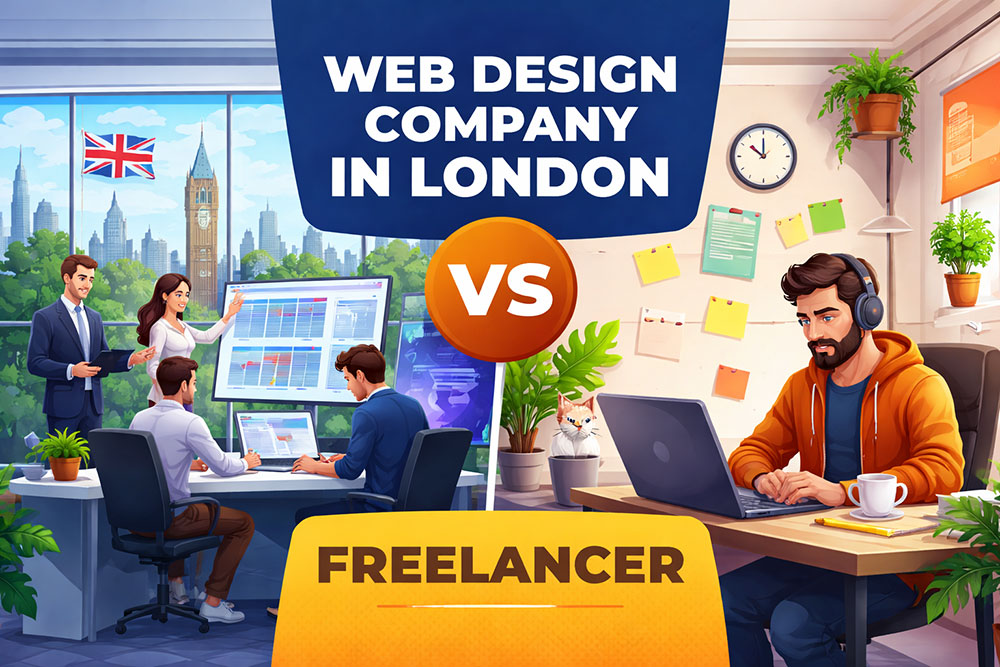
Agency vs freelancer comparison
At-a-glance comparison table
|
Factor |
Web design company (London agency) |
Freelancer |
|
Best for |
Growth-focused SMEs, B2B lead gen, ecommerce, regulated or security-sensitive work, tighter governance |
Small sites, design-only projects, specific technical tasks, early-stage budgets |
|
Strength |
Multi-skill team, continuity, structured delivery, broader coverage (design/UX/dev/SEO/support) |
Direct access, flexibility, often lower overhead, fast for focused scope |
|
Main trade-off |
Higher minimum budgets; process may feel “structured” vs ad-hoc |
Single point of failure; capacity limits; variable PM/compliance depth |
|
Risk profile |
Lower operational risk if the firm is stable and supports handover/documentation |
Higher continuity risk if the freelancer becomes unavailable |
|
Typical engagement style |
Proposal + Statement of Work, milestones, change control; optional maintenance retainer |
Fixed fee or day/hour rates; depends heavily on individual working style |
Price ranges and timelines vary widely and depend on scope, content readiness, integrations, and compliance requirements. The next sections show how those variables translate into budget and delivery outcomes in the London/UK market.
Cost and pricing models
The biggest misconception is that “freelancer = cheap” and “agency = expensive.” In practice, you are buying time, expertise, and risk reduction—and those elements are priced differently depending on the delivery model.
Freelancers commonly price in one of three ways: hourly, day rate, or fixed project fee (often derived from expected days). In the UK market data published by YunoJuno, average 2024 day rates varied by discipline, including Design (£367/day), Developer (£438/day), and UX (£425/day) (with role-based variation above and below those averages).
Agency pricing typically packages multiple roles (strategy, design, dev, QA, PM). On webdesignserviceslondon.co.uk, example starting points include basic website design from £1,000+, enhanced websites from £2,550+, eCommerce from £2,900+, and custom projects from ~£5,000+ (depending on scope and complexity).
For broader context, several UK pricing guides also describe ranges that scale quickly with complexity, including small-business brochure sites in the low thousands and custom builds into five figures. Treat these as directional benchmarks rather than quotes.
A practical way to compare is to ask: “What is included in the price?” A lower fee can still be expensive if it excludes essentials like analytics setup, technical SEO basics, redirects for a redesign, cookie compliance support, or post-launch fixes.
Quality and expertise
A freelancer can be excellent—especially if you need a very specific skill (e.g., UI design, conversion-focused landing pages, Shopify theme customization, or WordPress performance work). But with freelancers, “quality” is tightly linked to one person’s strengths and availability.
A web design company is more likely to deliver consistent quality across disciplines because it can combine design, development, SEO, and governance practices into a single delivery process. webdesignserviceslondon.co.uk positions agency selection around evaluating multi-discipline capability (design/development/SEO/branding/automation), which reflects the reality that a modern business website usually needs more than one skill set to perform well.
For UK and London buyers, quality also includes compliance readiness—not just aesthetics—because privacy, cookies, and data handling expectations affect trust and risk exposure.
Project management and timelines
Agencies typically have more structured delivery: discovery, design, development, QA, and launch—often with milestones and formal approvals.
From the webdesignserviceslondon.co.uk timeline guidance, “most websites take between 2 and 12 weeks,” with smaller sites sometimes faster and custom platforms stretching longer (especially if approvals or content are slow).
Freelancers can be very fast for tightly scoped work because there’s less coordination overhead. However, the timeline becomes fragile when scope expands or when the freelancer must juggle multiple clients. Agencies can often maintain momentum by shifting work across team members, but only if the scope and approvals are managed properly.
A useful question to ask either provider: “What happens if content is late or scope changes?” Strong providers will have an explicit change-control approach (even if informal) that protects both parties.
Communication and availability
Freelancers often offer the simplest communication model: you speak directly with the person doing the work. That can reduce translation errors and speed up iteration.
Agencies may route communication through a project manager or account lead, which can feel less direct—but can also reduce confusion and keep delivery organized as complexity grows. For buyers who need predictable responsiveness, agencies sometimes publish formal support hours; for example, webdesignserviceslondon.co.uk states assistance hours and response expectations via its contact and quote pages.
For London B2B clients, communication risk is often less about friendliness and more about decision latency: who approves changes, how quickly feedback comes back, and whether stakeholders can align. That’s why structured timelines emphasize fast approvals as a major determinant of delivery speed.
Scalability and resources
Scalability is the clearest structural advantage of an agency model.
If you anticipate adding more service pages, location pages, integrations (CRM, booking, payments), or parallel marketing initiatives, an agency can typically allocate additional delivery capacity faster than a solo freelancer. Freelancers can scale by subcontracting, but that introduces “mini-agency” complexity—often without the same formal QA and governance.
This matters in London markets where businesses may need to iterate quickly (e.g., adding new landing pages, launching seasonal campaigns, or responding to competitor moves). London’s large business base reinforces why speed and adaptability are strategic, not cosmetic.
Legal and contractual protections
Regardless of who you hire, a written contract is one of the strongest protections you have.
The UK Small Business Commissioner emphasizes that written contracts help protect businesses, reduce disputes, and clarify what is being provided, who is involved, and how the contract ends.
Two London/UK-specific due diligence steps add meaningful protection:
Verify incorporated agencies (and any freelancer operating as a limited company) using Companies House services, which provide free access to details like registered address, incorporation date, officers, and filings.
Confirm IP (intellectual property) terms in writing. The UK guidance on commissioned works states that the creator is typically the first owner of copyright unless you agree otherwise in writing—an issue that can apply directly to websites and collaborative builds.
Agencies often have standardized contracts, insurance arrangements, and internal processes for documentation and handover. Freelancers can provide the same protections, but you usually need to request them explicitly and verify they exist.
Ongoing support and maintenance
Websites are not “set and forget.” They require updates, monitoring, and occasional fixes.
From National Cyber Security Centre guidance, keeping devices and software up to date is a core security practice because outdated systems create avoidable risk.
On costs, UK guidance and market explainers commonly break spend into build + hosting + maintenance. For example, a UK cost breakdown aimed at small businesses distinguishes between initial build, hosting/app costs, and ongoing maintenance (though figures vary widely).
Agency maintenance is often offered as a retainer or package (updates, backups, security, small content changes). Freelancers may offer maintenance too, but continuity can be less predictable if they change focus or become unavailable. Given increased scrutiny around cookies and privacy, ongoing support is not only technical—it can also include ensuring your banner, policies, and tracking practices remain aligned with UK requirements.
Portfolio and case studies
A portfolio should do more than look good. It should prove that the provider can deliver outcomes similar to what you need: lead generation, ecommerce conversion, performance, SEO foundations, and industry fit.
A straightforward approach (also reflected in agency-selection guidance on webdesignserviceslondon.co.uk) is to review portfolio evidence for relevance, mobile responsiveness, structure, and performance signals.
For London B2B buyers, consider requesting at least one case study or reference that maps to your objective: inbound leads, booked calls, better-quality inquiries, or reduced admin via automation. A provider’s strongest value is often in how they think about business goals, not just how they design pages.
Local London advantages
“Local” matters less because of geography and more because of business context.
London has an unusually dense concentration of businesses, and it is also positioned as the largest UK tech cluster by value—both of which influence buyer expectations around UX polish, trust, and speed.
Practical London advantages can include:
Easier in-person or same-timezone collaboration for multi-stakeholder projects (marketing + leadership + sales).
Better familiarity with London market norms (service competition, local SEO needs, sector expectations).
Faster coordination for urgent changes (campaign launches, event pages, high-priority fixes).
Local does not automatically mean better, but it can reduce friction—especially when timelines are tight and decisions must move quickly.
How to choose
A reliable decision method is to choose based on (1) business impact, (2) risk tolerance, and (3) who owns ongoing responsibility.
If your website is mission-critical (lead gen, revenue, compliance, brand trust), it is rational to pay more for reduced delivery risk and stronger support. Written contracts and clear scope are key regardless of provider type.
Decision checklist table
|
Checklist item |
Why it matters |
What “good” looks like |
|
Scope clarity |
Prevents cost overruns and timeline creep |
Clear sitemap/pages, “must-haves,” exclusions, and change process |
|
Pricing model transparency |
Avoids hidden costs |
Fixed fees tied to deliverables or time & materials with caps; clear payment milestones |
|
Timeline realism |
Protects launch plans |
Delivery plan aligned with typical timelines; approvals/content dependencies made explicit |
|
SEO foundation included |
Protects discoverability and lead flow |
Technical SEO basics, clean structure, analytics/tracking plan; SEO discussed early |
|
Compliance readiness |
Reduces regulatory and trust risk |
Cookie consent approach aligns with ICO guidance; privacy notice discipline |
|
IP ownership in writing |
Prevents disputes over ownership |
Contract states IP assignment/license clearly; avoids ambiguity for commissioned work |
|
Continuity plan |
Prevents “single point of failure” |
Handover docs, repository access, admin credentials policy, maintenance options |
|
Proof of relevant work |
Predicts fit and outcomes |
Portfolio examples similar to your industry and objectives; measurable results when possible |
|
Ability to support growth |
Reduces rebuild frequency |
Scalable CMS/setup, design system, extensible architecture; optional retainer |
A simple heuristic that works well for London SMEs:
If you need a small, well-defined site and you can supply content quickly (or accept a template-led approach), a strong freelancer can be ideal.
If you need strategy + content structure + SEO + governance + ongoing support, a web design company is usually the safer choice.